How Long Does EtG Stay in Your Urine? (The Real Answer)
It's 1 AM. Your test is Monday morning. Every website gave you the same answer: "up to 80 hours." That number is not wrong — but it is almost useless for your situation.
Editorial note
This educational page is maintained by EtGCalc and reviewed against published EtG research, SAMHSA guidance, and our calculator methodology. It does not provide medical or legal advice.
What Is EtG?
EtG (ethyl glucuronide) is a direct metabolite of ethanol. When you drink, your liver processes ethanol through several pathways, and one produces EtG by attaching a glucuronic acid molecule to the ethanol. This process is called glucuronidation.
EtG matters for testing because ethanol itself leaves your body relatively fast — typically within 12 hours. But EtG lingers much longer. It follows first-order elimination kinetics, with a half-life of approximately 2 to 3 hours (Jatlow et al., 2014).
The time it takes for EtG to fall below a detectable cutoff depends entirely on where the concentration starts — which depends on how much you drank. Learn more about the math behind this in our guide to calculating EtG levels.
How Long Can Alcohol Be Detected in Urine by EtG?
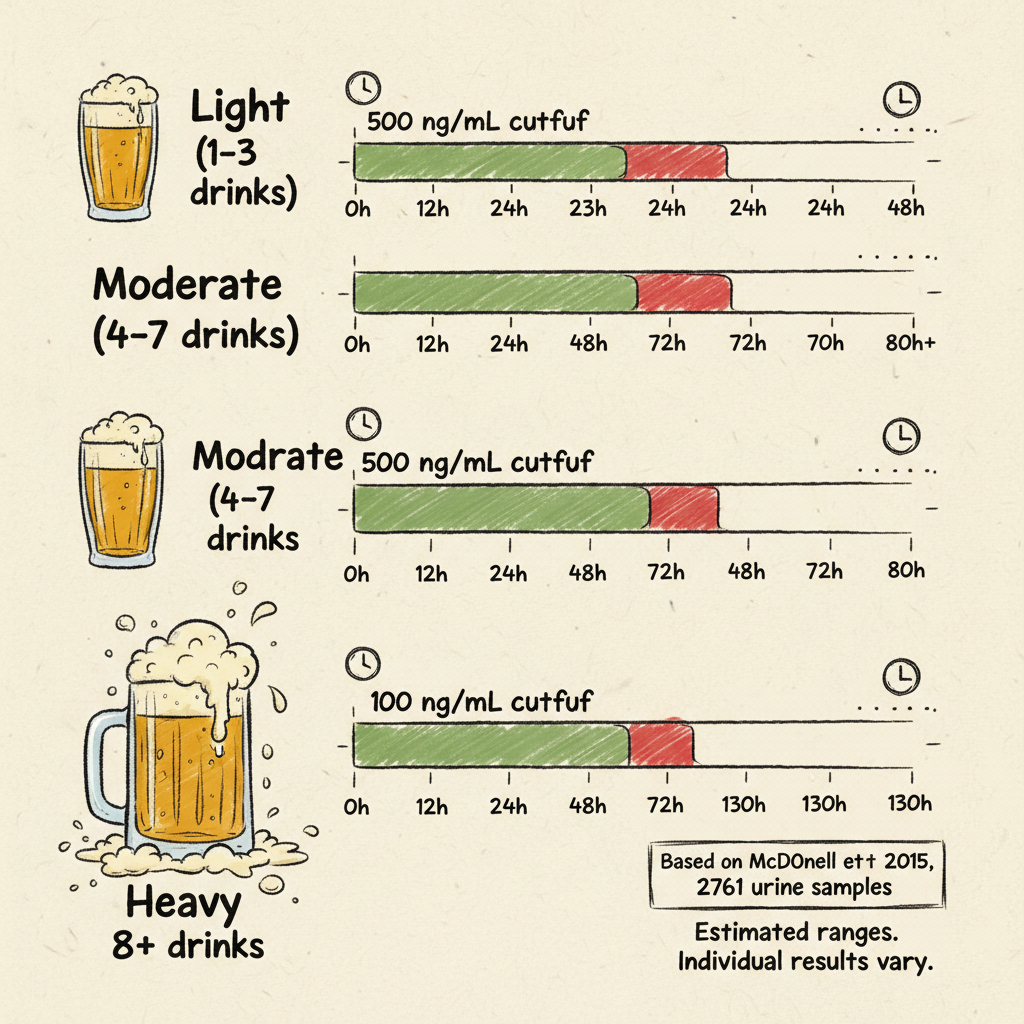
For many people, an EtG urine test can detect alcohol for about 24 to 72 hours, but that range is not a rule. Light drinking may fall below a 500 ng/mL cutoff much sooner, while heavy drinking or a 100 ng/mL cutoff can extend detection toward the upper end.
The exact window depends on four things: how much alcohol you consumed, your body size and sex, individual metabolism, and the lab cutoff. This is why two people can drink the same amount and get different EtG urine test results.
Quick estimate: If you need a scenario-specific answer, use the EtG Urine Test Calculator or compare your timing with the full EtG test guide.
The 4 Variables That Determine YOUR Detection Window
1. How Much You Drank (Dose)
The biggest factor. Because EtG elimination follows a logarithmic decay curve, doubling your drinks does not double your detection window — it adds a few more half-life cycles.
2. Body Weight and Sex (Widmark Factor)
The Widmark formula estimates peak BAC based on alcohol consumed, body weight, and the Widmark r factor (0.68 for males, 0.55 for females). A heavier person distributes alcohol across more body water, producing less EtG.
3. Individual Metabolism
Liver enzyme activity varies between individuals. Age, liver health, chronic alcohol use, and genetics all affect clearance speed. No calculator can perfectly predict this variable.
4. Test Cutoff Level (ng/mL)
This is the factor most people overlook. It can change your result by 1 to 2 full days. Learn more in our 100 ng/mL cutoff guide.
Stop guessing. Our EtG Calculator estimates your personal clearance timeline based on your weight, sex, number of drinks, and hours since your last drink.
Use the EtG Calculator →100% private. Runs entirely in your browser. No data saved or transmitted.
EtG Detection Times by Drinking Level
| Drinking Level | 500 ng/mL | 100 ng/mL |
|---|---|---|
| Light (1-3 drinks) | ~12-24 hours | ~24-48 hours |
| Moderate (4-7 drinks) | ~24-36 hours | ~48-72 hours |
| Heavy (8+ drinks) | ~48-72 hours | Up to 80-130h |
Based on McDonell et al. (2015), Drug and Alcohol Dependence, NIH-funded study analyzing 2,761 urine samples, with supplementary data from Jatlow et al. (2014).
EtG Detection Time by Drink Count and Drink Type
Searches like "EtG after 1 beer," "EtG after 2 drinks," or "EtG after wine" are really asking the same thing: how much ethanol entered your body, what cutoff is being used, and how much time has passed. Use this as educational context, not a guarantee of a lab result.
| Scenario | Approx. standard drinks | 500 ng/mL context | 100 ng/mL context | Best next step |
|---|---|---|---|---|
| 1 beer or 1 drink | ~1 | Often below cutoff within ~12-24 hours | May remain detectable longer, often up to ~24 hours | Run urine estimate |
| 2 drinks | ~2 | Often ~12-24 hours, depending on timing and body size | Can extend toward ~24-36 hours | Compare 24/48/72 hours |
| 3 beers or 3 drinks | ~3 | Often uncertain around 24 hours | May extend toward ~36-48 hours | Use the levels chart |
| Wine | Depends on pour size; 5 oz at 12% ABV is ~1 | Similar to beer when the ethanol dose is the same | Larger pours or multiple glasses can extend the window | Check standard drink math |
| Liquor | 1.5 oz at 40% ABV is ~1 | Shot size and mixed drinks can make estimates easy to undercount | Higher total dose means a longer tail below strict cutoffs | Estimate detection time |
Important: Beer, wine, and liquor do not create different EtG molecules. The practical difference is dose. A large glass of wine or a strong mixed drink can count as more than one standard drink.
100 ng/mL vs 500 ng/mL: Why the Cutoff Changes Everything
Person A — 500 ng/mL (Workplace)
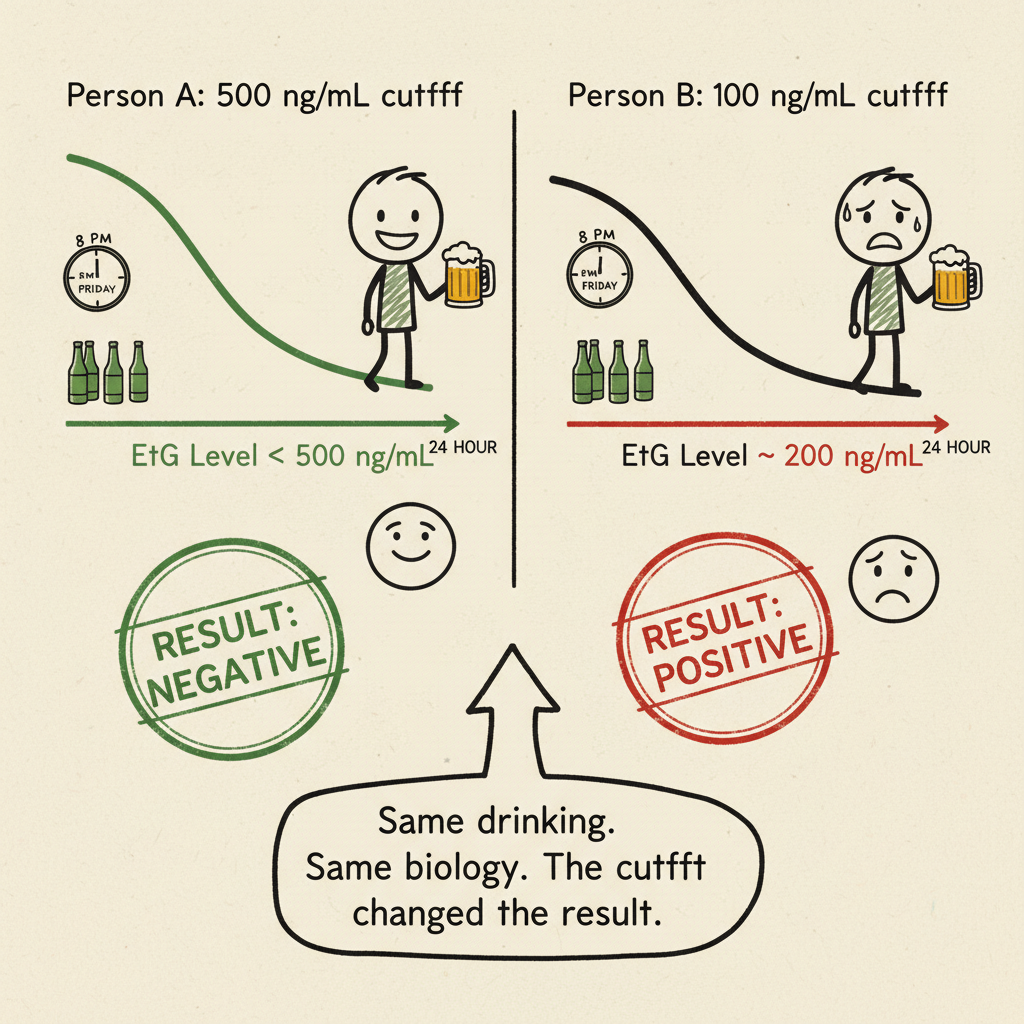
Same 4 beers at 8 PM Friday. By Saturday evening (~24 hours), EtG drops below 500 ng/mL. Result: Negative.
Person B — 100 ng/mL (Court)
Same drinking, same biology. At 24 hours, EtG is still ~200 ng/mL. Needs another 12-24 hours. Result: Positive.
Key takeaway: Same drinking. Same biology. Opposite outcome. The only difference was the number on the lab order. If you don't know your cutoff, assume 100 ng/mL and plan accordingly.
What Does NOT Speed Up EtG Elimination
Excessive water — Dilutes urine but doesn't speed metabolism. Labs test for dilution.
"Detox" drinks — No published evidence supports faster EtG elimination.
Exercise and sweating — EtG is eliminated via kidneys, not sweat.
Time is the only proven factor that clears EtG from your system.
Can You Get a False Positive EtG Result?
Yes. SAMHSA's 2012 advisory identified several sources of incidental ethanol exposure that can produce EtG levels above 100 ng/mL without drinking:
Hand Sanitizer
heavy use
Mouthwash
ethanol-based
Medications
liquid form
Kombucha
trace alcohol
This is one reason SAMHSA recommended the 500 ng/mL cutoff for clinical interpretations. If you believe incidental exposure caused a positive, learn about EtG vs EtS confirmation testing and how to discuss results with your provider.
Frequently Asked Questions
What if I only had one drink? Will it show up on an EtG test?
A single standard drink typically produces EtG levels that fall below the 500 ng/mL cutoff within 12 hours. At the 100 ng/mL cutoff, it may be detectable for up to 24 hours. Use our EtG Calculator for a personalized estimate.
Will 3 beers show up on an EtG test after 24 hours?
At the 500 ng/mL cutoff, 3 standard beers are unlikely to be detectable after 24 hours in most individuals. At the 100 ng/mL cutoff, detection is possible up to 36-48 hours. Body weight and metabolism also affect clearance time.
Can you dilute EtG out of your system by drinking water?
Excessive water intake can dilute urine concentration but does not remove EtG from your body faster. Labs routinely test for dilution, and an overly dilute sample may be rejected or treated as a positive.
How accurate is the EtG urine test?
EtG is a highly sensitive biomarker for recent alcohol exposure. At the 500 ng/mL cutoff, studies show strong specificity (few false positives). At 100 ng/mL, sensitivity increases but so does the risk of detecting incidental ethanol exposure.
Does EtG detection time depend on body weight?
Yes. Heavier individuals distribute alcohol across more body water (Widmark formula), producing lower peak EtG levels and generally shorter detection windows compared to lighter individuals who consumed the same amount.
Disclaimer: This article is for educational and informational purposes only. It does not constitute medical, legal, or clinical advice. EtG Calculator estimates are based on the Widmark formula and published pharmacokinetic data. Individual results may vary due to differences in liver function, hydration status, and other biological factors. Never rely solely on a calculator to make decisions about legal compliance.
Sources: McDonell, M.G., et al. (2015). Drug and Alcohol Dependence, 157; Jatlow, P.I., et al. (2014). Alcoholism: Clinical and Experimental Research, 38(7); SAMHSA (2012).
Related Reading
For a personalized estimate, use our EtG Calculator with your weight, drinks, and time since drinking.
Medical & Legal Disclaimer
Not Medical Advice
EtGCalc does not provide diagnosis, treatment, or medical advice. Talk with a qualified healthcare provider about alcohol use, metabolism, testing concerns, or recovery.
Not Legal Advice
EtG testing can affect probation, custody, licensing, and employment decisions. Consult a licensed attorney or your testing program for legal questions.
If You Need Support
In the United States, SAMHSA's National Helpline is 1-800-662-4357. It is free, confidential, and available 24/7.
Calculator output is an estimate, not a test prediction. Individual metabolism, hydration, kidney function, genetics, specimen handling, and lab cutoff policy can change real results. See our methodology and sources.
References
- 1SAMHSA. The Role of Biomarkers in the Treatment of Alcohol Use Disorders, 2012 Revision.
Used for biomarker context, cutoff interpretation, and incidental exposure cautions.
- 2Jatlow et al. Ethyl glucuronide and ethyl sulfate assays in clinical trials, 2014.
Used for urinary EtG and EtS kinetics after alcohol exposure.
- 3McDonell et al. Using ethyl glucuronide in urine to detect alcohol use, 2015.
Used for EtG detection window context in clinical monitoring populations.
Get Your Personalized Estimate
Enter your weight, number of drinks, and hours since your last drink. The calculator runs entirely in your browser. Nothing is saved or transmitted.
Open Calculator